


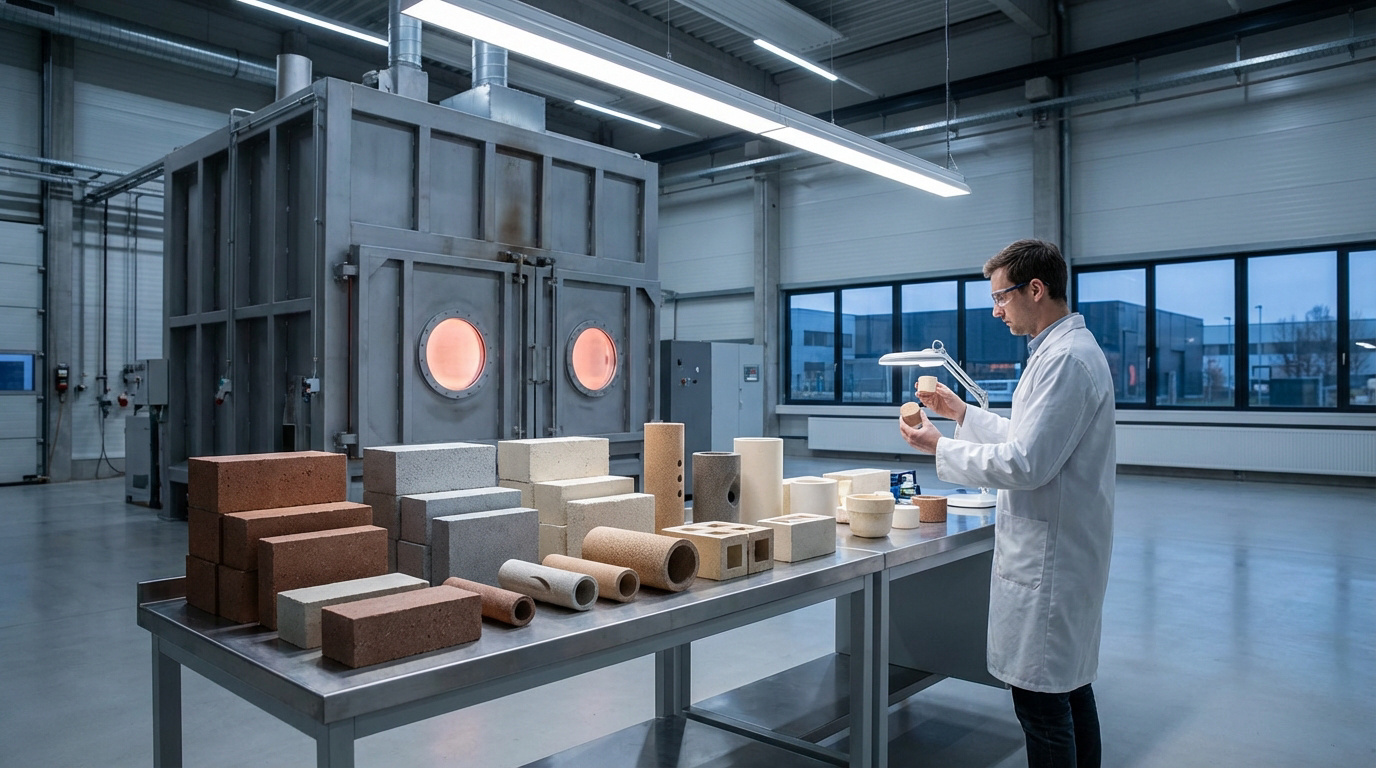
Key takeaway: thermal performance rests on the balance between service temperature, chemical compatibility and mechanical strength. Choosing high-alumina or silicon carbide materials ensures long service life against thermal shock and abrasion. A cold crushing strength above 30 MPa and a porosity below 20% are critical indicators of durability.
Are your plants suffering costly shutdowns caused by premature lining wear? A rigorous selection process for high-temperature refractories, based on chemical compatibility and thermal shock resistance, protects your industrial assets. Discover how the technical trade-off between high-alumina bricks and monolithic solutions optimizes your energy performance while extending the service life of equipment exposed to extreme operating conditions.
- Which criteria drive the selection of industrial refractories?
- Technical classification by material composition and morphology
- 3 levers to maximize furnace energy performance
- Toward predictive maintenance of high-temperature linings
Which criteria drive the selection of industrial refractories?
With the stage set for industrial performance, it is time to examine the technical parameters that determine how long a furnace lining lasts.
Determine the peak temperature and cycling frequency
Identify the maximum temperature in continuous service. Exceeding the safe limit causes premature melting. This is the first selection filter.
Analyze the severity of thermal shocks. Frequent shutdowns crack overly rigid materials through differential thermal expansion.
Assess the risk of creep under load. At high temperature, the weight of the structure can deform weakened bricks.
Assess chemical compatibility with slags and gases
Define whether the operating environment is acidic or basic. A pH mismatch between slag and brick leads to runaway corrosion. Be especially vigilant on this point.
Anticipate reactions with molten metals. Metal infiltrating the porosity destroys the structure from within.
Measure the impact of gases. Some volatile compounds react chemically and cause the lining to spall through internal crystallization, hence the value of properly matched refractory products for industry.
Anticipate physical erosion caused by material flow
Quantify mechanical abrasion stresses. Friction from solid materials wears the surface away by particle pull-out. Hardness must exceed the applied load. Often overlooked, yet crucial for overall service life.
Select dense materials. Charging zones endure repeated, violent impacts.
Verify resistance to gas velocity. High-speed flows strip away surface particles.
Technical classification by material composition and morphology
Once the constraints are identified, let us take a closer look at the arsenal of solutions available on the market.
Weighing brick stability against the flexibility of monolithics
Shaped bricks deliver optimum dimensional stability thanks to prior firing at the plant. Their preformed structure ensures high mechanical strength. They are ideal for large straight walls.
Monolithic castables allow fast on-site installation. These materials conform perfectly to complex geometries without weak joints. The time savings are considerable.
The final trade-off depends on the geometry of your equipment. The choice often comes down to access for bricklayers or gunning crews. Consider a refractory inspection to validate your installation.
Ranking alumina contents and chemical grades
Performance depends directly on alumina content. The higher the content, the more dramatically thermal resistance increases. Standard fireclay is sufficient for lower temperatures.
Magnesia is the preferred choice for alkaline environments. These materials stand up effectively to the basic slags found in steel plants. They are indispensable in modern steelmaking.
AZS materials offer very low porosity. This characteristic protects installations against corrosion by molten glass. See the research on fused-cast refractory materials for more detail.
Using silicon carbide in high-abrasion zones
Silicon carbide offers high thermal conductivity. It transfers heat quickly toward the cooling systems. This effectively protects the furnace’s steel structure.
Its acid resistance is a major asset. The material is completely unfazed by aggressive chemical atmospheres. It maintains remarkable physical stability.
The initial capital outlay is amply justified by durability. Its exceptional service life reduces costly production shutdowns. The payback calculation speaks for itself.
3 levers to maximize furnace energy performance
Choosing the right material is not enough; it must also be installed intelligently so you don’t throw energy out the window.
Combining lightweight bricks and fibers to reduce thermal inertia
Integrating refractory ceramic fibers is a winning strategy. They act as an ultra-lightweight thermal shield. This drastically limits heat losses.
Using insulating firebricks as a back-up lining is essential. They protect the furnace’s steel casing. It is a fundamental thermal safety barrier for your installation.
Calculating the fuel savings then becomes a priority. High-performance insulation cuts the energy bill dramatically. Give it serious thought.
Following dry-out and heat-up protocols
Controlling the initial setting time is your first operational imperative. Drying too fast causes irreversible shrinkage cracks. Water must escape without building up internal pressure. For the installer, it is a stage that demands absolute patience.
Following a precise firing curve safeguards the integrity of the system. The heat-up must be gradual. This prevents explosive spalling of castables under steam pressure.
Achieving final mechanical cohesion demands extreme rigor. Controlled curing ensures the strength of the lining. It is the guarantee of a durable, cost-effective installation.
Toward predictive maintenance of high-temperature linings
Finally, the future of the sector lies in our ability to anticipate wear rather than endure it.
Analyzing failure modes to refine the specification
Diagnosing the causes of premature wear is imperative. Examining failures often reveals a poor initial choice. Every production campaign should be a learning opportunity.
Adjusting the grain size distribution effectively limits porosity. A tighter structure blocks alkali infiltration. It is a technical customization that changes everything in the field. This fine-tuning buys precious months of additional operation.
Validate technical equivalence. Never switch suppliers without testing actual properties through failure mode and effects analysis (FMEA).
Leveraging connected sensors to anticipate replacement
Tracking residual lining thickness by thermography is now possible. Sensors detect hot spots before a furnace breakout occurs. It is a vital safety measure for your teams.
Harnessing digital technology delivers unprecedented visibility. Data makes it possible to schedule maintenance shutdowns at the ideal moment. You avoid unplanned, particularly costly breakdowns.
Reducing overall operating costs becomes a reality. Customizing wear zones optimizes material purchasing in line with the refractory requirements specification. This is modern asset management.
Mastering temperature, chemical compatibility and mechanical strength safeguards the longevity of your installations. Selecting the right refractory products protects your assets and immediately improves your energy yields. Act now to secure your production cycles: thermal excellence is the foundation of your future profitability.