



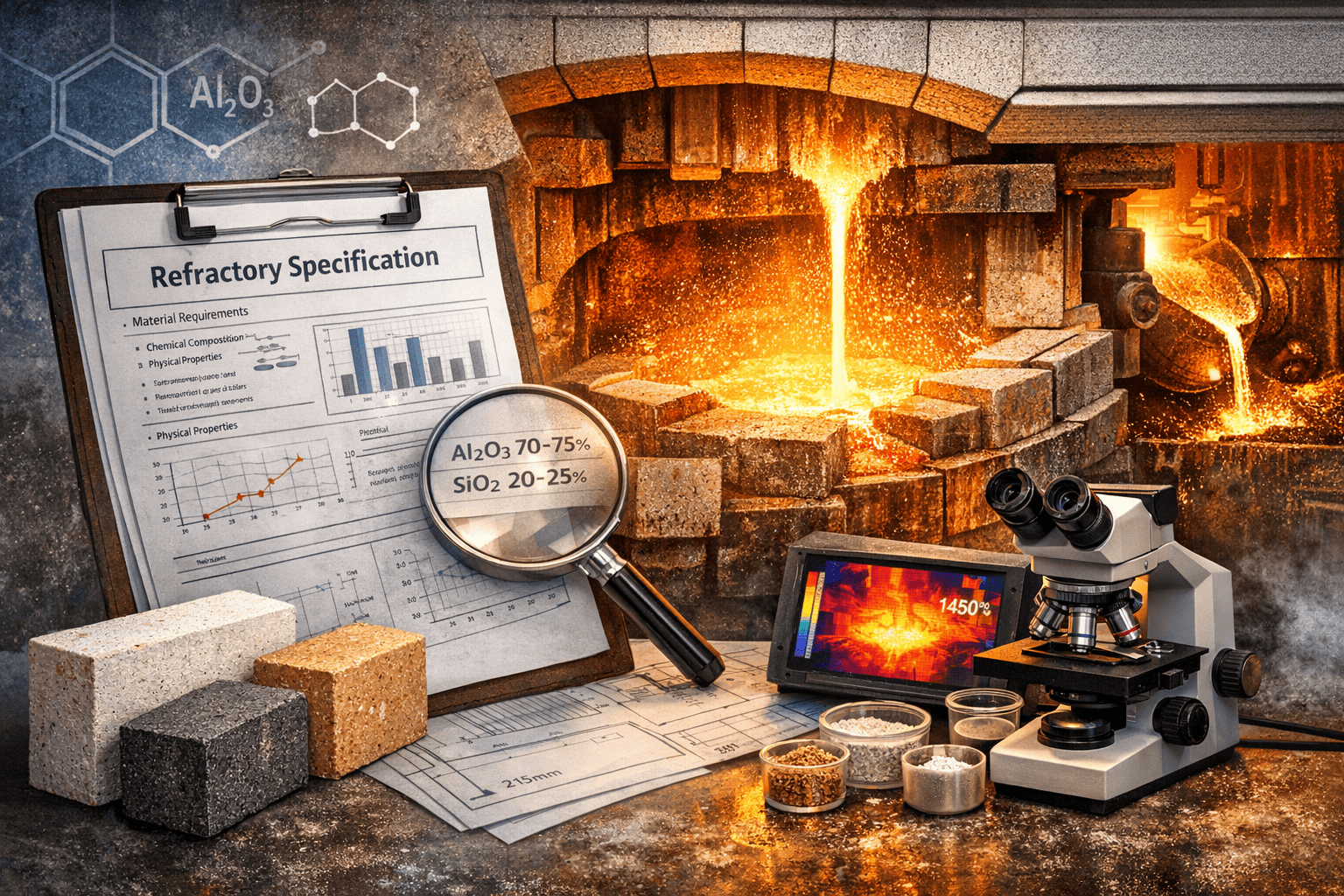
Dans les industries à haute température telles que le verre, l’acier, le ciment ou la métallurgie des non-ferreux, les performances des fours industriels reposent en grande partie sur la qualité et l’adéquation des matériaux réfractaires. Ces matériaux constituent le revêtement protecteur des fours, fours de cuisson et réacteurs, protégeant les équipements des températures extrêmes, des attaques chimiques et des contraintes mécaniques.
Pourtant, une étape critique est souvent sous-estimée lors de la conception ou de la maintenance des fours : la spécification réfractaire.
Une la spécification réfractaire bien définie n’est pas un simple document technique. C’est un outil d’ingénierie stratégique qui garantit que les matériaux réfractaires appropriés sont sélectionnés, fabriqués et installés pour répondre aux exigences spécifiques d’un procédé. Sans spécification précise, même des produits réfractaires de haute qualité peuvent connaître une défaillance prématurée s’ils ne sont pas adaptés à l’environnement opérationnel.
C’est pourquoi les entreprises travaillant avec des partenaires spécialisés tels que MXS-Refractories accordent une grande importance à la phase de spécification avant toute décision d’achat ou d’installation.
Comprendre le rôle des matériaux réfractaires dans les fours industriels
Les matériaux réfractaires sont conçus pour résister à des températures pouvant dépasser 1500°C, tout en conservant leur stabilité structurelle et leur résistance chimique. Dans de nombreux procédés industriels, ils jouent également un rôle clé dans le maintien de l’efficacité thermique et la protection de la structure du four.
Selon l’industrie, les revêtements réfractaires peuvent être exposés à :
- des températures extrêmes et des gradients thermiques
- des laitiers corrosifs ou des métaux en fusion
- des bains de verre agressifs
- une abrasion mécanique
- des cycles rapides de chauffage et de refroidissement
Chacun de ces facteurs influence le comportement des matériaux réfractaires au fil du temps.
Par exemple, dans les fours verriers, les matériaux réfractaires électrofondus tels que AZS sont souvent utilisés au contact du verre fondu en raison de leur excellente résistance à la corrosion. À l’inverse, les zones d’isolation peuvent nécessiter des matériaux réfractaires légers à faible conductivité thermique afin d’améliorer l’efficacité énergétique.
Sélectionner le mauvais matériau dans la mauvaise zone peut entraîner plusieurs problèmes opérationnels :
- une corrosion accélérée
- une fissuration structurelle
- des pertes thermiques
- une contamination du procédé
C’est précisément pourquoi la la spécification réfractaire doit être abordée comme un processus d’ingénierie détaillé.
Pourquoi la spécification réfractaire est plus qu’une sélection de matériaux
Une idée reçue courante est que la spécification réfractaire consiste simplement à sélectionner une nuance de matériau dans le catalogue d’un fournisseur.
En réalité, une spécification réfractaire appropriée définit un cadre complet pour la conception, la fabrication et le contrôle qualité des produits réfractaires.
Une spécification robuste comprend généralement :
Exigences de composition chimique
La composition chimique des matériaux réfractaires détermine leur résistance à la corrosion, aux attaques chimiques et leur stabilité à haute température.
Par exemple, les matériaux utilisés dans les zones en contact avec le verre doivent présenter une forte résistance à la corrosion par le verre et un risque de contamination minimal.
Propriétés physiques et mécaniques
Les paramètres importants peuvent inclure :
- la densité
- la porosité
- la résistance à l’écrasement à froid
- la dilatation thermique
- la réfractarité sous charge
Ces propriétés influencent le comportement du revêtement réfractaire sous contrainte opérationnelle.
Exigences relatives au procédé de fabrication
Les performances des matériaux réfractaires ne sont pas déterminées uniquement par la composition chimique. Les procédés de fabrication tels que la fusion, le coulage, le pressage ou la cuisson peuvent influencer de manière significative la microstructure et la durabilité.
Une spécification bien rédigée définit les méthodes de production acceptables et les normes de qualité.
Tolérances dimensionnelles
Des dimensions incorrectes peuvent entraîner des problèmes d’installation, des joints trop larges et une stabilité réduite du four.
Contrôle qualité et essais
La spécification doit définir les méthodes d’essai et les critères d’acceptation pour chaque lot de réfractaires.
Cela peut inclure :
- analyse chimique
- mesure de la densité
- examen microstructural
- essais mécaniques
En définissant clairement ces paramètres, les entreprises peuvent s’assurer que les fournisseurs livrent des matériaux réfractaires répondant de manière constante aux exigences opérationnelles.
L’impact d’une mauvaise spécification réfractaire
Lorsque la spécification réfractaire est incomplète ou mal définie, les exploitants industriels peuvent être confrontés à plusieurs risques cachés.
Durée de vie du four réduite
Si les matériaux ne sont pas adaptés aux conditions de fonctionnement, l’usure des réfractaires peut s’accélérer de façon spectaculaire.
Cela peut conduire à des reconstructions prématurées du four ou à des réparations d’urgence.
Coûts opérationnels accrus
Des matériaux réfractaires mal sélectionnés entraînent souvent une consommation d’énergie plus élevée en raison de pertes de chaleur accrues.
Les interventions de maintenance peuvent également devenir plus fréquentes.
Problèmes de qualité des produits
Dans des industries telles que la fabrication du verre, la dégradation des réfractaires peut introduire des défauts dans le produit final.
Des particules issues de la corrosion des réfractaires peuvent contaminer le bain de fusion, entraînant des inclusions ou des pierres.
Risques pour la sécurité
Une défaillance grave des réfractaires peut compromettre l’intégrité du four et créer des dangers importants pour la sécurité.
Pour ces raisons, la spécification réfractaire doit toujours être considérée comme une étape d’ingénierie critique plutôt que comme une simple exigence d’achat.
L’importance d’une expertise réfractaire indépendante
De nombreuses entreprises industrielles s’appuient principalement sur les fournisseurs de réfractaires pour définir les spécifications des matériaux. Bien que les fournisseurs apportent une expertise précieuse, leurs recommandations peuvent naturellement se concentrer sur leur propre gamme de produits.
C’est là qu’un accompagnement technique indépendant devient extrêmement précieux.
Des cabinets de conseil spécialisés tels que MXS-Refractories fournissent une expertise indépendante en la spécification réfractaire, aidant les exploitants industriels à sélectionner les matériaux et les fournisseurs les plus adaptés sur la base d’exigences techniques plutôt que de considérations commerciales.
Cette approche permet aux entreprises de :
- définir des spécifications réfractaires précises
- comparer objectivement différents fournisseurs
- optimiser la conception du four et la configuration du revêtement
- améliorer la fiabilité du four à long terme
Le conseil indépendant en réfractaires contribue également à garantir que les spécifications restent alignées sur les dernières normes industrielles et évolutions technologiques.
La spécification réfractaire comme investissement stratégique
Les fours industriels représentent souvent des investissements de plusieurs millions d’euros. Le revêtement réfractaire, bien qu’il ne représente qu’une fraction de ce coût, joue un rôle décisif dans la fiabilité et la durée de vie du four.
Une spécification réfractaire bien conçue peut apporter des avantages significatifs à long terme :
- des campagnes de four prolongées
- une efficacité énergétique améliorée
- des coûts de maintenance réduits
- une qualité de produit accrue
- une sécurité opérationnelle améliorée
Dans ce contexte, la phase de spécification doit être considérée comme un investissement plutôt que comme une dépense.
Les entreprises qui accordent une attention suffisante à l’ingénierie des réfractaires lors des phases de conception et d’achat obtiennent souvent des avantages opérationnels substantiels sur toute la durée de vie de leurs équipements.
Conclusion
Les matériaux réfractaires sont l’épine dorsale de tout procédé industriel à haute température. Leurs performances influencent directement la fiabilité du four, l’efficacité énergétique et la qualité des produits.
Cependant, atteindre des performances optimales exige davantage que le simple achat de produits réfractaires. Cela nécessite une la spécification réfractaire précise et bien structurée, qui définit les propriétés exactes des matériaux, les procédés de fabrication et les exigences de contrôle qualité nécessaires pour chaque application de four.
En travaillant avec des spécialistes expérimentés tels que MXS-Refractories, les exploitants industriels peuvent s’assurer que leurs systèmes réfractaires sont conçus et spécifiés pour répondre aux conditions opérationnelles les plus exigeantes.
Dans les industries à haute température, une spécification réfractaire bien définie n’est pas un simple détail technique, c’est un facteur clé de réussite opérationnelle à long terme.