



In the glass industry, fused-cast AZS (Alumina-Zirconia-Silica) refractories are among the most critical components of any melting furnace. Their performance directly influences furnace stability, product quality, operational efficiency, and total lifecycle cost. Despite their widespread use, one technical detail is often underestimated: the importance of maintaining non-machined surfaces in all glass-contact zones.
While machining might seem like a way to improve dimensional precision or surface finish, it can actually compromise the integrity and long-term performance of AZS refractories. As industrial operators and engineers strive for higher furnace efficiency and cleaner glass production, understanding why non-machined AZS surfaces are preferred becomes increasingly important.
This article explores the technical reasons behind this practice and how it connects with the expertise offered by MXS Refractories for companies seeking reliability and performance in their refractory strategy.
1. The Role of AZS Refractories in Glass Furnaces
AZS refractories are the backbone of most glass furnaces due to their unique combination of:
-
High corrosion resistance
-
Resistance to molten glass attack
-
Thermal shock stability
-
Strong mechanical properties under load
-
Ability to withstand long-term chemical and thermal stress
These properties are vital in furnace areas such as sidewalls, hot spots, throat sections, working ends, and feeder channels. Because these zones are in direct contact with molten glass, even minor defects or irregularities can cause contamination, reduced clarity, or shortened furnace life.
This is where the surface condition of AZS blocks becomes critical.
2. Why the Glass-Contact Surface Should Not Be Machined
a. Preserving the Natural As-Cast Microstructure
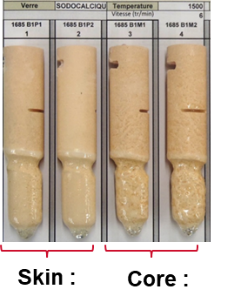
During casting, AZS blocks solidify in a way that creates a dense, compact microstructure. The outer surface—the one naturally in contact with the mold—forms a sealed, homogeneous layer with minimal porosity.
Machining breaks this natural surface and exposes:
-
Microcracks
-
Micro-porosity
-
Interruption of the crystal network
-
More reactive zones within the material
These alterations can weaken the block and significantly accelerate wear once installed in the furnace.
Keeping the surface non-machined ensures that the natural, densified layer remains intact.
b. Reduced Chemical Reactivity with Molten Glass
Molten glass is highly aggressive at furnace operating temperatures. When it comes into contact with a machined surface, the exposed microcracks and irregularities can:
-
Trap molten glass
-
Trigger localized corrosion
-
Create pathways for glass penetration
-
Accelerate matrix glass exudation
-
Release small particles into the melt
This increases the risk of defects such as cords, seeds, knots, and inclusions in the final glass product.
A non-machined surface acts as a protective barrier, reducing chemical interactions and keeping the glass melt cleaner.
c. Improved Thermal Stability and Stress Distribution
Machining can disturb the density and continuity of the material near the surface. These disturbances create unequal heat distribution and make the material more susceptible to thermal shock.
In contrast, an as-cast surface:
-
Maintains uniform thermal conductivity
-
Minimizes local thermal gradients
-
Reduces stress accumulation
-
Improves resistance to thermal cycling
In high-temperature environments where thermal shocks are inevitable, preserving the natural surface condition greatly enhances reliability.
d. Better Surface Smoothness for Glass Quality
The as-cast finish of AZS blocks is naturally smoother and more consistent than a machined surface. Machining introduces microscopic grooves and unevenness, which can negatively affect molten glass flow and the surface quality of the final product.
This is especially critical in sectors such as:
-
Container glass
-
Tableware
-
Solar glass
-
Pharmaceutical glass
-
High-clarity specialty glass
A smooth, non-machined interface reduces the risk of marking, dragging, or defect generation.
e. Longer Refractory Lifetime and Lower Operational Costs
Because non-machined AZS blocks maintain their natural density and continuity, they:
-
Resist corrosion longer
-
Show slower erosion rates
-
Better withstand mechanical stresses
-
Maintain performance deeper into the campaign
This directly translates into extended furnace life and reduced maintenance costs.
3. How the Microstructure Supports Non-Machined Use
AZS refractories combine crystalline phases (mainly zirconia and alumina) with a glassy matrix that fills the gaps between crystals. Their performance relies on the balance between:
-
Toughness from zirconia crystals
-
Strength from corundum
-
Flexibility and stress absorption from the glassy matrix
Machining disrupts this balance by fracturing the glassy phase and weakening the bond between crystals. By leaving the surface as-cast, the block retains maximum microstructural stability.
Furthermore, the natural as-cast layer has lower porosity and better sealing properties, helping to resist glass infiltration over time.
4. The Importance of Process Control in Casting AZS Blocks
For a non-machined surface to perform well, the casting process must ensure:
-
Homogeneous melting
-
Controlled zirconia phase distribution
-
Proper cooling rate
-
Uniform surface consolidation
-
Minimal internal stress
High-quality manufacturing naturally produces a surface that does not require machining. This is why furnace designers, engineers, and refractory specialists increasingly prioritize the use of as-cast blocks over machined alternatives.
5. Supporting Industrial Performance
For companies seeking to optimize refractory selection, improve furnace performance, or understand wear mechanisms, MXS Refractories provides specialized expertise based on decades of industrial experience.
The expertise includes:
-
Technical assessments of refractory installations
-
Guidance in selecting non-machined AZS blocks for critical zones
-
Evaluation of supplier quality and casting processes
-
Optimization of furnace design and material configuration
-
Support during factory acceptance tests and on-site inspections
-
Troubleshooting of corrosion, exudation, and glass contamination issues
By integrating technical knowledge with field experience, MXS Refractories helps industrial customers achieve greater reliability, cleaner glass production, and longer refractory service life.
Conclusion
Keeping AZS blocks non-machined in glass-contact zones is not just a manufacturing preference—it is a technical requirement for achieving optimal furnace performance. The as-cast surface offers superior resistance to corrosion, better thermal stability, reduced contamination risk, and a longer operational lifespan.
Combined with proper manufacturing and expert guidance, non-machined AZS refractories serve as a critical foundation for efficient, clean, and reliable glass production. For companies aiming to strengthen their technical strategy and performance, MXS Refractories stands ready to support them with high-level expertise and practical insight.