

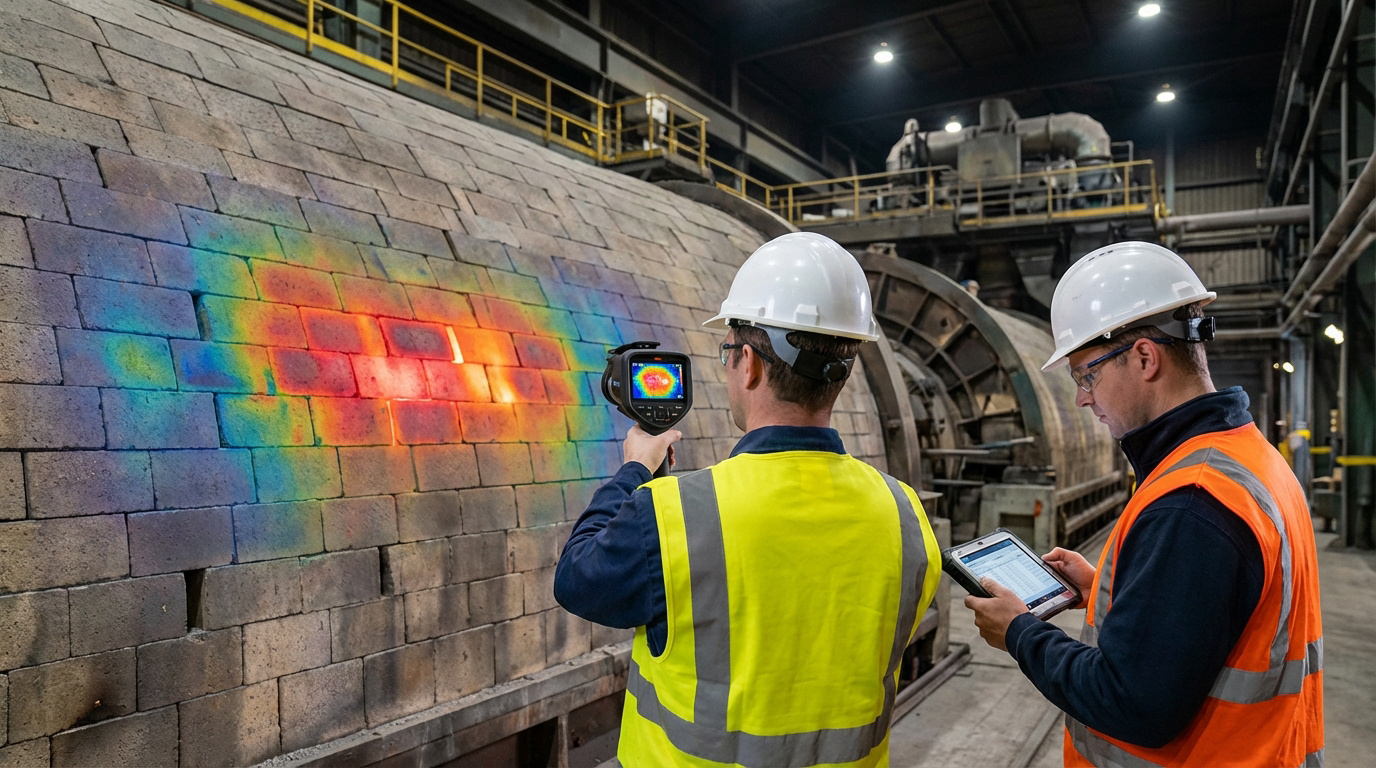
Key takeaway: a field audit combines rigorous visual inspection with advanced technologies such as infrared thermography to diagnose wear without interrupting production. This preventive approach protects your assets by identifying structural pathologies before failure occurs. Thanks to millimetre-accurate laser scanning, you obtain a precise 3D map of the lining, guaranteeing cost-effective predictive maintenance and extended service life for your installations.
An unexpected thermal failure can paralyse your production and generate colossal loss-related costs. To protect your assets, we detail here how to audit an industrial refractory lining through a rigorous field diagnosis and the analysis of brick pathologies. This expertise will allow you to anticipate structural wear using infrared thermography and laser scanning in order to optimise your maintenance cycles without any interruption to operations.
- Refractory lining audit protocol: the key steps of the field diagnosis
- 3 diagnostic technologies to assess the lining without a production shutdown
- How do thermal cycles influence degradation?
- Maintenance management and industrial risk control
Refractory lining audit protocol: the key steps of the field diagnosis
Having set out the framework of industrial performance, we now get straight to the heart of the matter with the rigour required for a proper examination of the installations.
Identifying pathologies and visual survey of the brickwork
Spalling and delamination often signal deep structural fatigue. These physical degradations result from thermal shock or mechanical stress. Every zone must be mapped in order to anticipate brick fallout and secure the thermal enclosure.
Examining the joints remains a decisive step. The mortar is frequently the weak link in the assembly. Pronounced joint erosion weakens the entire lining, accelerating the infiltration of molten metal or aggressive slag.
Documenting every anomaly makes it possible to build a reliable history. These precise records are the foundation of any serious maintenance strategy. To that end, calling on refractory materials expertise guarantees an uncompromising technical diagnosis.
Preparing the site visit and collecting performance data
Defining the scope of the intervention prevents you from going in blind. Reviewing the technical history and the installation drawings is an essential prerequisite. You do not set foot on site without mastering the background record.
Analysing production data correlates the observed wear with actual service hours. This cross-check reveals whether the degradation is normal or premature. This is where you detect anomalies linked to intensive thermal cycling.
Preparing the measurement tools ensures the reliability of the results. Calibrating hand-held instruments and thermal cameras for surface readings is imperative. Rigorous preparation dictates the accuracy of future technical decisions.
3 diagnostic technologies to assess the lining without a production shutdown
While the expert eye is irreplaceable, technology now makes it possible to see what is invisible to the naked eye, especially while the furnace is still hot.
Infrared thermography and hot spot detection
Infrared cameras detect invisible thermal leaks. Every hot spot constitutes a potential alert for the installation. Swift action is required. The objective is to intervene before the heat reaches the metal of the shell.
Interpreting temperature gradients is essential. We compare the readings against the original design drawings. This analysis makes it possible to indirectly quantify the thickness loss of the worn insulating lining.
Thermal images validate our field hypotheses. They confirm the suspicions raised by the visual inspection. It is a rapid decision-making tool.
Laser scanning and endoscopy of inaccessible areas
Laser scanning precisely measures wall thinning. This method guarantees millimetre-level accuracy. You obtain a true 3D view without any physical contact.
Endoscopic inspection explores narrow ducts. Probes penetrate dark or confined areas. It is the only way to verify internal integrity without dismantling anything.
In-service diagnosis avoids cooling the equipment down completely. Keeping production running protects the installation while saving time. For an independent refractory expert, this is a major economic trade-off. You maintain performance without sacrificing safety. Pairing these inspections with digital monitoring solutions takes the approach even further.
How do thermal cycles influence degradation?
Understanding the current condition is one thing, but anticipating how the materials will react to future stresses is quite another, and far more complex.
Thermomechanical modelling and finite element analysis
We simulate internal stresses to identify where the materials are suffering. During heat-up, modelling precisely visualises the zones of maximum tension at the core of the structure.
Anticipating cracking then becomes possible. Since thermal expansion is often abrupt, we calculate the elastic limits. This prevents catastrophic ruptures during critical heating cycles.
Finally, we adjust the heat-up curves based on the computational results. The objective is to optimise your process. Premature wear is reduced while guaranteeing the longevity of your industrial installations.
Impact of the atmosphere and charging rate
Chemical corrosion analysis reveals how process gases attack the bricks. This molecular degradation, slow but irreversible, requires rigorous monitoring to maintain overall integrity.
Mechanical abrasion depends directly on the charging rate. The faster the material flow, the more the lining is thinned by friction. It is an essential tuning parameter for performance.
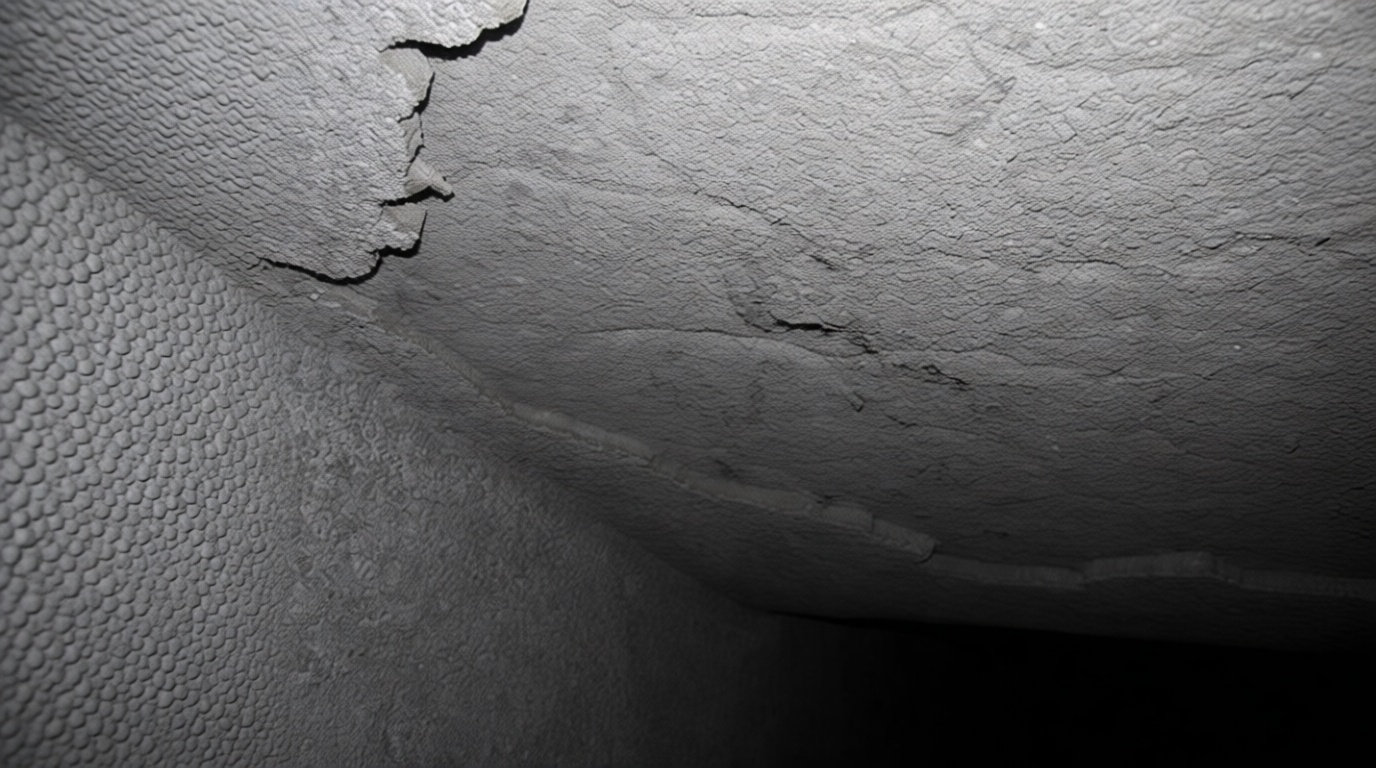
Yet everything comes back to thermal shock. Load variations create abrupt temperature swings. The refractory must then absorb these mood swings without breaking.
Maintenance management and industrial risk control
Once the diagnosis has been made and the causes identified, what remains is to define the action plan that will safeguard the production asset for the long term.
Hot repair strategies and precision gunning
Gunning makes it possible to spray monolithic refractory castable. Gaps are filled without shutting down the furnace. It is a highly effective short-term solution for extending a production campaign.
Priority is given to zone-based maintenance. Intervention takes place only where it is needed. This limits the impact on the plant’s overall schedule. It is a pragmatic approach to industrial asset management.
Training the teams remains paramount. Personnel must be able to recognise the first signs of failure. Early detection, combined with the 5S method for operational excellence, often saves entire installations.
Technical arbitration and selection of suitable materials
The choice of refractory materials is decisive. The brick must be matched to the specific constraints of the site. Never sacrifice quality for a penny-wise initial saving.
Managing relationships during a loss event demands neutrality. The expert acts as a bridge between the operator and the builder. Their role is to find a technically and financially acceptable common ground.
Optimising the supply chain protects your assets. Guaranteeing the availability of spare parts is vital. A well-managed stock avoids weeks of forced shutdown over a single missing brick.
Mastering the audit of an industrial refractory lining guarantees the safety of your teams and the continuity of your operations. By combining rigorous visual inspection, thermography and thermal cycle modelling, you anticipate critical failures. Act now to turn your maintenance into a lever for lasting performance. Secure your production asset for the future.