



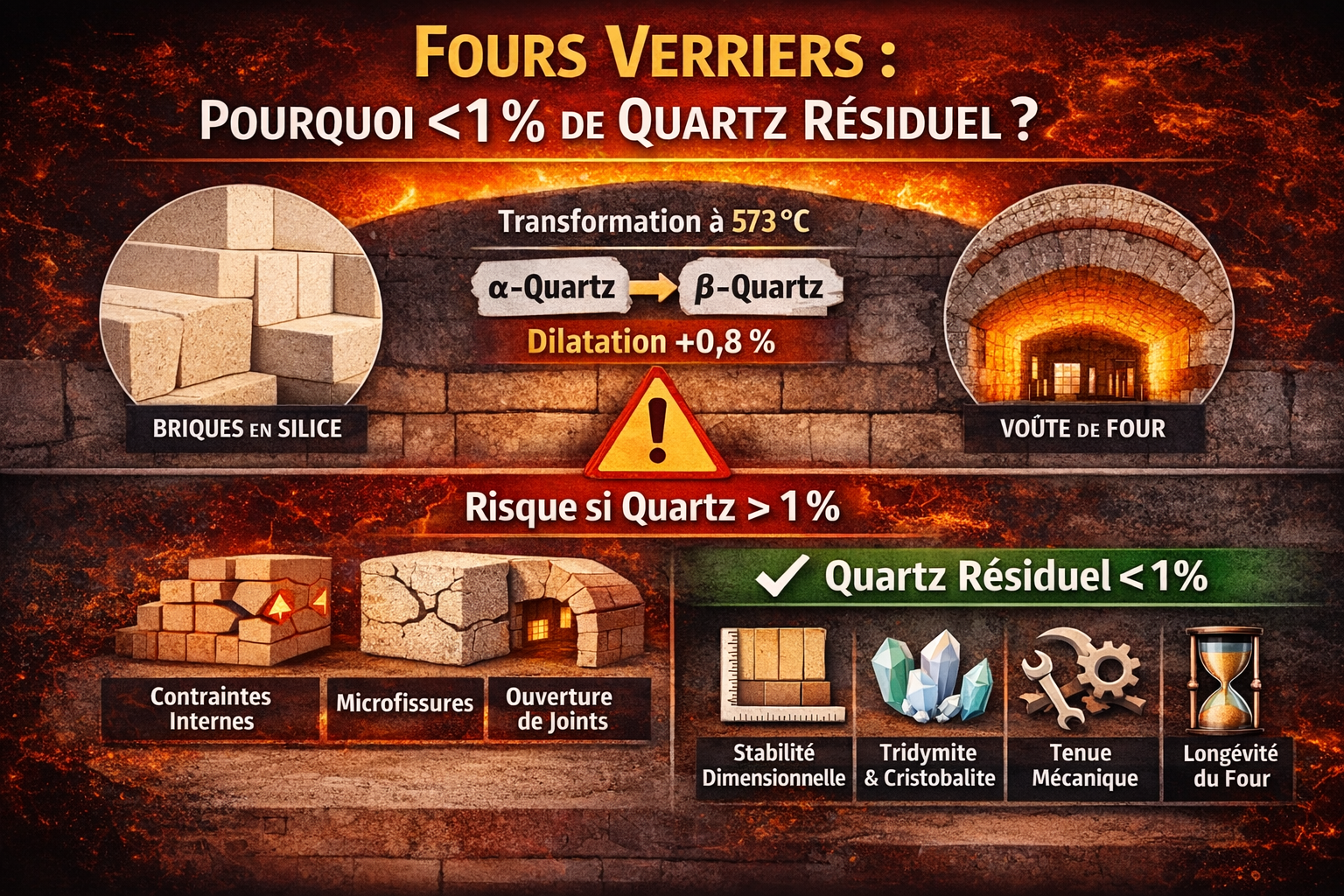
Dans les briques réfractaires de silice utilisées dans les fours à verre, le contrôle de la teneur en quartz résiduel est critique. C’est pourquoi les spécifications techniques exigent généralement moins de 1% de quartz résiduel.
1. Une transformation de phase qui génère des variations de volume dangereuses
Le quartz subit une transformation cristallographique du quartz α au quartz β à 573 °C.
Cette transformation produit une variation de volume soudaine (≈0.8%).
Dans une brique déjà installée dans un four à verre, cela peut :
-
générer des contraintes internes significatives
-
provoquer des microfissures ou une fissuration structurelle
-
perturber la stabilité de la voûte du four
Dans les fours à verre, où la stabilité dimensionnelle est essentielle, ce phénomène peut devenir un risque opérationnel majeur.
2. Les briques doivent déjà être stabilisées avant l’installation
Lors de la fabrication, la cuisson doit convertir la quasi-totalité du quartz en :
Ces phases sont thermodynamiquement stables dans la plage de températures de service des fours à verre (typiquement 1400–1650 °C).
Si une quantité significative de quartz subsiste, cela signifie que la transformation minéralogique est incomplète.
Par conséquent, la transformation de phase peut encore se produire pendant le fonctionnement du four, ce qui est clairement inacceptable.
3. Un facteur de risque pour la durée de vie du four
Dans les zones critiques telles que :
-
la voûte
-
la la superstructure
-
la les parois supérieures du four
les contraintes mécaniques sont déjà élevées.
Un excès de quartz résiduel peut entraîner :
-
une déformation de la voûte
-
une ouverture des joints
-
un affaiblissement des briques
À terme, cela peut considérablement réduire la durée de campagne du four.
4. Pourquoi la norme industrielle est <1%
Les fabricants de réfractaires ont établi par l’expérience que :
-
<1% de quartz résiduel garantit que les transformations critiques ont déjà eu lieu
-
la microstructure est dominée par la tridymite et la cristobalite
-
le réfractaire présente une excellente stabilité dimensionnelle en service
Pour cette raison, <1% de quartz résiduel est devenu une référence industrielle pour les briques de silice utilisées dans les applications de fours à verre.
En résumé
Maintenir moins de 1% de quartz résiduel garantit :
-
aucune variation de volume dangereuse à 573 °C
-
une stabilité dimensionnelle élevée
-
la sécurité mécanique de la voûte du four
-
une durée de campagne maximale du four.