



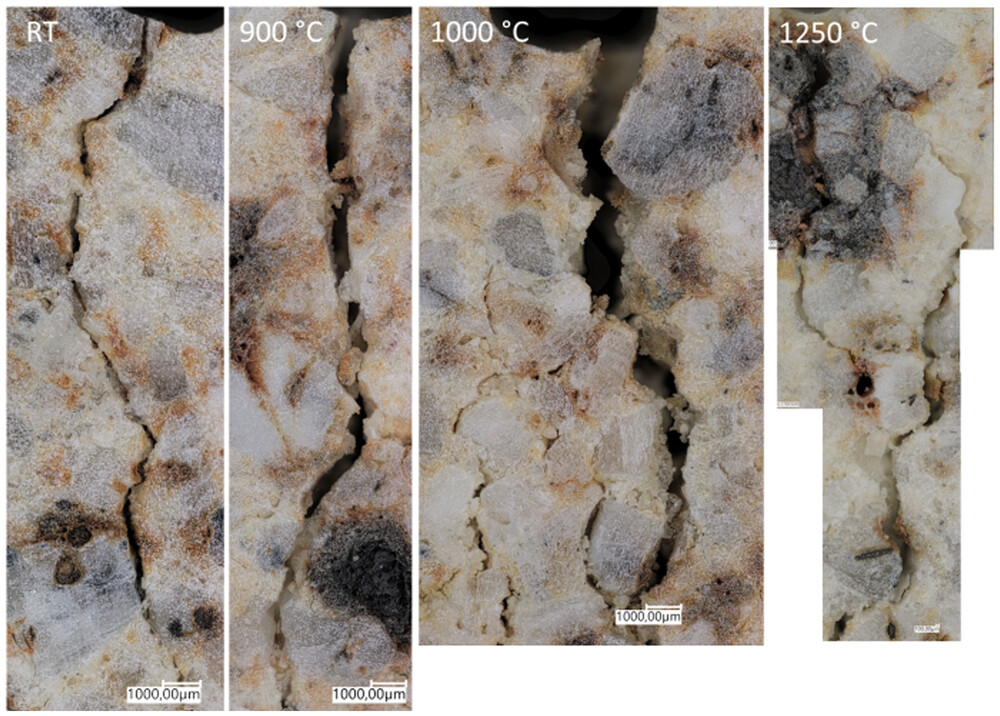
In high-temperature industrial processes, refractory materials are the silent backbone of operations. Whether in glass furnaces, steel ladles, cement kilns, non-ferrous metallurgy, or petrochemical units, refractories are constantly exposed to extreme thermal, mechanical, and chemical constraints. Among all degradation mechanisms affecting refractories, thermal shock remains one of the most critical, and often underestimated, factors governing service life.
At MXS-Refractories, we consider thermal shock resistance (TSR) not as a secondary property, but as a strategic performance indicator directly linked to operational reliability, safety, and total cost of ownership.
What Is Thermal Shock in Refractories?
Thermal shock occurs when a refractory material is subjected to rapid temperature changes, either heating or cooling, that generate internal stresses exceeding the material’s mechanical strength. These stresses originate from temperature gradients within the refractory lining, causing differential expansion or contraction between the hot face and the cold face.
If these stresses are not properly accommodated, the refractory may experience:
-
Microcracking
-
Macrocracking
-
Structural spalling
-
Premature failure of blocks, bricks, or monolithic linings
Thermal shock is particularly severe during start-ups, shutdowns, emergency stops, burner failures, cold air ingress, batch charging, or water contact.
Why Thermal Shock Resistance Determines Refractory Longevity
A refractory with excellent chemical resistance but poor thermal shock behavior may fail long before reaching its theoretical corrosion limit. In contrast, a material with optimized TSR can tolerate repeated thermal cycles without catastrophic damage, ensuring longer campaign life and stable furnace operation.
High thermal shock resistance directly translates into:
-
Reduced unplanned shutdowns
-
Lower maintenance and repair costs
-
Improved operational flexibility
-
Enhanced safety for personnel and equipment
-
Predictable lining behavior over time
In many industrial applications, the number of thermal cycles endured by a refractory is just as important as the maximum operating temperature.
Key Material Properties Influencing Thermal Shock Resistance
Thermal shock resistance is not a single intrinsic property but the result of a complex interaction of physical, mechanical, and microstructural parameters.
1. Thermal Expansion Coefficient
Materials with low or moderate thermal expansion generate lower internal stresses during temperature changes. Sudden expansion mismatch is a primary driver of crack initiation.
2. Thermal Conductivity
Higher thermal conductivity allows heat to distribute more evenly through the material, reducing temperature gradients and localized stress concentration. However, this must be balanced against insulation requirements.
3. Elastic Modulus
A lower elastic modulus enables the refractory to deform slightly under stress, absorbing thermal strain rather than fracturing. “Rigid” materials tend to crack more easily under thermal shock.
4. Mechanical Strength and Fracture Toughness
While high cold crushing strength (CCS) is important, fracture toughness plays a more decisive role in resisting crack propagation once microcracks form.
5. Microstructure and Porosity
Controlled porosity and engineered microcrack networks can act as stress relief mechanisms. In some cases, a slightly higher porosity improves TSR by dissipating thermal stress energy.
Microcracking: A Controlled Advantage
Contrary to intuition, the presence of controlled microcracks can be beneficial. These microcracks:
-
Interrupt crack propagation
-
Relieve internal stresses
-
Improve resistance to catastrophic spalling
This principle is well-known in fused-cast refractories such as AZS, where microstructural design plays a crucial role in long-term performance under cyclic thermal loads.
Thermal Shock in Real Operating Conditions
Laboratory tests (water quenching, air quenching, repeated heating cycles) provide useful benchmarks, but real furnace conditions are far more complex. Factors such as:
-
Heating and cooling rates
-
Furnace geometry
-
Installation quality
-
Joint design
-
Operating discipline
-
Atmosphere and chemical attack
all influence how thermal shock manifests in service.
A refractory with excellent TSR on paper can still fail prematurely if start-up procedures are too aggressive or if local hot spots develop due to burner misalignment or airflow disturbances.
Design and Operational Strategies to Improve Thermal Shock Performance
Thermal shock resistance is not solely a material issue—it is also a design and operational challenge.
Key mitigation strategies include:
-
Selecting refractories adapted to thermal cycling severity, not only peak temperature
-
Optimizing lining thickness and expansion joints
-
Ensuring proper installation and drying procedures
-
Implementing controlled heat-up and cool-down schedules
-
Monitoring temperature gradients and hot spots
-
Avoiding sudden cold air or liquid ingress whenever possible
At MXS-Refractories, we work closely with customers to align material selection, furnace design, and operating practices.
MXS-Refractories’ Approach to Thermal Shock Resistance
Our philosophy is based on application-driven refractory engineering. Rather than offering generic solutions, we evaluate:
-
Process conditions
-
Thermal cycling frequency
-
Mechanical constraints
-
Chemical environment
-
Maintenance philosophy
We then recommend materials—shaped or monolithic—with optimized thermal shock behavior, balancing strength, flexibility, and durability.
This approach ensures that refractories do not merely survive extreme temperatures, but remain reliable under the real operational stresses that define industrial performance.
Conclusion: Thermal Shock Resistance as a Strategic Performance Factor
In modern industrial operations, flexibility is essential. Frequent start-ups, shutdowns, and production changes are now standard. Under these conditions, thermal shock resistance becomes one of the most decisive factors for refractory longevity.
Investing in the right refractory solution—designed to withstand thermal cycling rather than just high temperatures—pays off through extended service life, improved safety, and reduced total operating costs.
At MXS-Refractories, we believe that mastering thermal shock resistance is not just about materials—it is about understanding the process as a whole and delivering refractory solutions that perform where it truly matters: in real furnaces, under real conditions, over the long term.